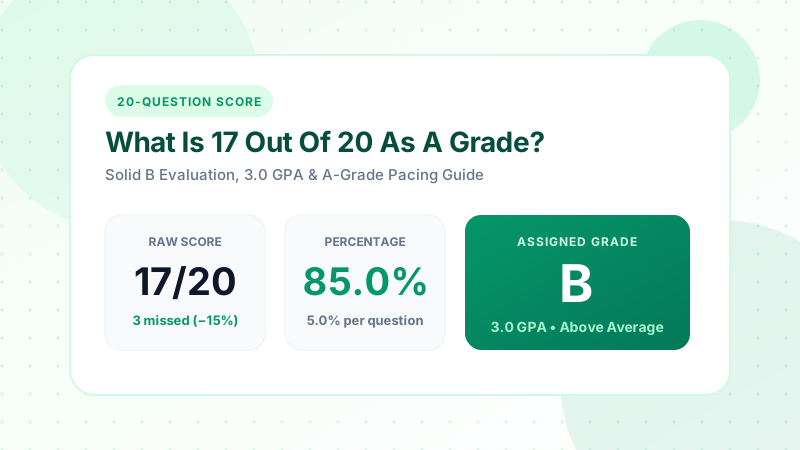
17 out of 20 is exactly 85.00%, which earns a solid letter grade of B on the standard United States 10-point grading scale. On a 20-question test, each question carries a value of 5 percentage points. Missing 3 questions deducts 15 percentage points, yielding an unweighted 3.0 GPA.
What Is 17 Out of 20 as a Percentage and Letter Grade?
A score of 17 out of 20 equals 85%, calculated by dividing 17 points earned by 20 points possible and multiplying by 100 ((17 ÷ 20) × 100 = 85%). On the standard United States academic scale, an 85% is placed right in the heart of the solid B bracket, which generally extends from 83.0% to 86.9%.
Because the test contains 20 items, each individual question accounts for 5.0 percentage points (100% ÷ 20 = 5%). Earning 17 correct answers means you missed 3 questions: 17 correct is 85% (B), 18 correct is 90% (A−), and 16 correct is 80% (B−).
An 85% is widely recognized as an above-average, commendable academic performance across middle schools, high schools, and universities. It demonstrates that you mastered 85% of the assessed objectives. While it falls just shy of the honor-tier A bracket, it serves as a robust foundation for maintaining a high GPA.
Complete 20-Question Score Reference Table (From 0/20 to 20/20)
Whether evaluating a classroom quiz, unit test, or practice exam, having the full score distribution available provides immediate clarity. Here is how every score from 0 to 20 translates on a standard plus/minus grading system:
To convert any other custom test length, enter your score directly into our score out of X converter or consult the grading scale for 20 questions breakdown.
| Questions Correct | Questions Missed | Percentage Score | Standard Letter Grade | Unweighted GPA Points |
|---|---|---|---|---|
| 20 | 0 | 100.0% | A+ / A | 4.0 |
| 19 | 1 | 95.0% | A | 4.0 |
| 18 | 2 | 90.0% | A− | 3.7 |
| 17 | 3 | 85.0% | B | 3.0 |
| 16 | 4 | 80.0% | B− | 2.7 |
| 15 | 5 | 75.0% | C | 2.0 |
| 14 | 6 | 70.0% | C− | 1.7 |
| 13 | 7 | 65.0% | D | 1.0 |
| 12 | 8 | 60.0% | D− | 0.7 |
| 11 | 9 | 55.0% | F | 0.0 |
| 10 | 10 | 50.0% | F | 0.0 |
| 9 | 11 | 45.0% | F | 0.0 |
| 8 | 12 | 40.0% | F | 0.0 |
| 7 | 13 | 35.0% | F | 0.0 |
| 6 | 14 | 30.0% | F | 0.0 |
| 5 | 15 | 25.0% | F | 0.0 |
| 4 | 16 | 20.0% | F | 0.0 |
| 3 | 17 | 15.0% | F | 0.0 |
| 2 | 18 | 10.0% | F | 0.0 |
| 1 | 19 | 5.0% | F | 0.0 |
| 0 | 20 | 0.0% | F | 0.0 |
Why 17 Out of 20 Is a B (And Why B+ Is Unreachable on 20 Questions)
A common puzzle for students scoring 17/20 is whether their 85% qualifies for a B+. On standard plus/minus scales, it does not, due to the arithmetic spacing of 20-question tests.
In standard academic grading, a B+ requires at least 87.0% (spanning from 87.0% to 89.9%). With 17 correct answers, you earn exactly 85.0%. To reach 87.0%, a student would need to answer 17.4 questions correctly (20 × 0.87 = 17.4).
Because test questions are scored in whole units, the next available score is 18 correct, which produces 90.0%. But 90.0% is not a B+; it immediately crosses the threshold into the A− band. Consequently, on a 20-question test without partial credit, the B+ grade simply does not exist.
However, if your teacher awards half-credit for partially correct solutions, earning 17.5 out of 20 results in 87.5%, which successfully unlocks the B+ letter grade.
What Would It Take to Get an A on a 20-Question Test?
To earn an A on a 20-question exam, the rules depend on whether your school employs a plus/minus system or a straight letter scale:
Missing 3 questions (17/20) places you exactly one question away from the A− boundary. Understanding that a single additional correct answer would have elevated your score from 85% to 90% underscores the importance of reviewing avoidable errors.
- On a Plus/Minus Scale (A− vs Solid A): To earn an A− (90.0%), you can miss at most 2 questions (18/20 = 90.0%). To earn an un-minused solid A (93.0%+), you can only miss 1 question (19/20 = 95.0%).
- On a Non-Plus/Minus Scale (Straight A at 90.0%): Any score of 90% or higher is recorded simply as an A. On this system, missing 2 questions (18/20) earns a full A and a 4.0 GPA contribution.
How Does 17 Out of 20 Compare Across Different Grading Scales?
Grading scales differ substantially depending on whether you are enrolled in a standard US public high school, a private academy, or a college abroad.
In regional school districts adhering to the strict 7-point scale (where an A is 93–100, B is 85–92, C is 77–84, and D is 70–76), 17 out of 20 (85%) is the exact lowest score that still qualifies as a B. Missing a fourth question (16/20 = 80%) would drop your grade all the way to a C. You can explore regional differences in our 10-point vs 7-point grading scale guide.
| Grading System | Percentage for 17/20 (85%) | Assigned Letter Grade | Standing & GPA Notes |
|---|---|---|---|
| Standard 10-Point Scale (US Public) | 83.0% – 86.9% | B | 3.00 GPA (Above Average / Honor Standard) |
| Strict 7-Point Scale (Select US Districts) | 85.0% – 92.9% | B / C+ | 3.00 GPA (Sits at the exact bottom threshold of B) |
| Standard College Plus/Minus Scale | 83.0% – 86.9% | B | 3.00 Quality Points |
| Canadian University Scale | 85.0% – 89.9% | A / A− | 3.70 – 3.90 (Excellent achievement in most provinces) |
| UK Undergraduate Honours System | 70.0%+ | First Class Honours (1st) | Top academic classification |
What Is the GPA Impact of a 17 Out of 20 (85%) Score?
On the standard United States 4.0 grading scale, an 85% (B) carries 3.00 grade points. In an honors course with +0.5 weighting it earns 3.50 quality points, and in an Advanced Placement (AP) or IB course with +1.0 weighting it earns 4.00 quality points.
A 3.00 GPA is the universal benchmark for good academic standing, Greek life eligibility, athletic compliance, and state scholarship renewals. Scoring an 85% on your assessments keeps you comfortably on track to meet or exceed that 3.0 threshold.
To see how an 85% factors into your multi-semester average, run your transcript through our cumulative GPA calculator and high school GPA calculator.
How Much Does an 85% Quiz Affect Your Overall Semester Grade?
Your overall course grade is determined by the weight of the quiz category in your course syllabus. Because an 85% is a solid score, its impact on your grade depends primarily on where your current average stands:
- You Hold a 92% (A−) and Quizzes Are 15% of the Grade: If this 17/20 quiz accounts for 3% of your total semester grade, your average experiences a negligible dip of 0.21 percentage points to 91.79%, comfortably preserving your A− standing.
- You Hold a 78% (C+) and Quizzes Are 20% of the Grade: If this quiz represents 5% of the course, your average rises from 78.0% to 78.35% (a +0.35 boost), helping you climb toward a B−.
How to Turn an 85% Quiz Score into an A by the End of the Semester
Starting the semester with an 85% on a 20-question quiz leaves you within striking distance of finishing with an A (93%) or A− (90%).
If you took two 20-question quizzes and want an overall quiz average of 90% (A−), calculate the needed score: (2 × 90) − 85 = 95% (19 out of 20). Hitting 19/20 on quiz two raises your combined quiz average right to 90.0%.
Furthermore, major exams carry 40% to 60% of the grade, while quizzes carry 15% to 20%. Scoring a 94% on your first midterm will dilute the minor point loss from a 17/20 quiz. Finally, use our final grade calculator to project what score you need on your final exam to secure an overall course A.
Frequently Asked Questions
What is 17 out of 20 as a percentage?+
17 out of 20 is exactly 85%. To calculate this percentage, divide 17 by 20 to get 0.85, then multiply by 100.
What letter grade is 17 out of 20?+
17 out of 20 is a B on the standard 10-point United States grading scale. It falls squarely into the regular B bracket (83% to 86.9%).
Is 17 out of 20 an honor roll grade?+
Yes, in most academic institutions, an 85% (3.0 GPA) qualifies for the B Honor Roll or Merit Roll. Top-tier Principal's Honor Roll typically requires a 3.5 or 3.75 GPA, which corresponds to an A− or A average.
Why is 17 out of 20 not a B+?+
17 out of 20 is not a B+ because the B+ bracket begins at 87.0%, which requires 17.4 correct questions on a 20-question test. Because whole-point tests jump by 5% increments, 17 correct is 85% (B) and 18 correct is 90% (A−), bypassing B+ entirely.
What GPA is 17 out of 20?+
On an unweighted 4.0 GPA scale, an 85% (B) translates to 3.00 grade points. In an honors class it is worth 3.50 points, and in an Advanced Placement (AP) course it earns 4.00 points.
What is 17 out of 20 on a 7-point grading scale?+
On a strict 7-point scale, 17 out of 20 (85%) is the lowest qualifying score for a B. Missing one more question (16/20 = 80%) drops the grade into the C range (77% to 84%).
How many questions can you miss on a 20-question test to get an A?+
To earn an A (93% or higher), you can only miss 1 question (19/20 = 95%). If your school considers 90% an A (non-plus/minus scale), you can miss up to 2 questions (18/20 = 90%).
How much is each question worth on a 20-question test?+
Each question is worth exactly 5.0 percentage points (100 ÷ 20 = 5%). Missing 1 question gives 95%, missing 2 gives 90%, and missing 3 gives 85%.
Can a 17 out of 20 be rounded up to an A−?+
No, standard grade rounding policies only round numbers within 0.5% (such as rounding 89.5% to 90.0%). An 85% is 5 percentage points away from 90%, which is far beyond the scope of rounding rules.
What is 17.5 out of 20 as a grade?+
If your teacher awards partial credit, 17.5 out of 20 equals 87.5%, which qualifies as a B+ on the standard plus/minus grading scale.
Is 17 out of 20 considered a good score on a college exam?+
Yes, an 85% on a college exam is a solid, above-average grade that comfortably satisfies all degree, major, and prerequisite requirements, maintaining good academic standing.
How do I figure out my grade if this quiz was only part of my overall marks?+
Multiply your quiz score (85%) by its percentage weight in the syllabus, then multiply your scores in all other categories by their respective weights and add the results together using our grade calculator.
Muhammd Salman
I build and maintain Grade Calculator independently. Every worked example on this site is checked against the underlying formula, with notes on where school or instructor policy can change the result. More about this site →