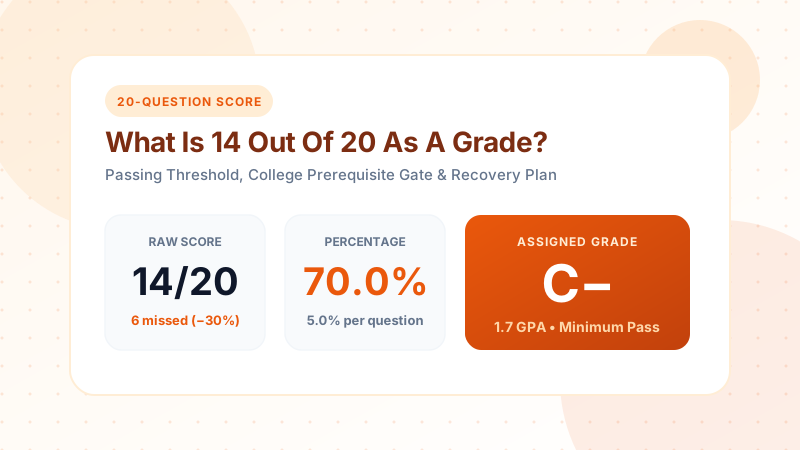
14 out of 20 is exactly 70.00%, which equals a C− (or a flat C on non-plus/minus scales) on the standard United States 10-point grading scale. On a 20-question test, each question is worth 5 percentage points. Missing 6 questions costs 30 percentage points, translating to a 1.7 to 2.0 GPA value.
What Is 14 Out of 20 as a Percentage and Letter Grade?
A score of 14 out of 20 represents 70%, determined by dividing 14 earned points by 20 possible points and multiplying by 100 ((14 ÷ 20) × 100 = 70%). On the standard United States academic scale with plus/minus distinctions, 70% sits at the exact bottom threshold of the C− band (which runs from 70.0% to 72.9%). In academic institutions that do not use minus grades, a 70% is recorded as a straight C.
Because the test contains 20 items, each individual question carries a weight of 5.0 percentage points (100% ÷ 20 = 5%). Earning 14 correct marks means you missed 6 questions: 14 correct is 70% (C−), 15 correct is 75% (C), and 13 correct is 65% (D).
A 70% is an entry-level passing grade. While it earns course credit in general education requirements, it sits on the borderline of academic concern, particularly in collegiate prerequisite courses that require a flat 2.0 (C) average to advance.
Complete 20-Question Score Conversion Chart (Every Mark from 0/20 to 20/20)
Below is the complete conversion matrix mapping every possible mark on a 20-question test to its exact percentage, standard letter grade, unweighted GPA quality points, and academic standing:
To evaluate any other custom exam length or partial-credit score, enter your numbers into our score out of X converter or inspect the grading scale for 20 questions breakdown.
| Questions Correct | Questions Missed | Percentage Score | Standard Letter Grade | Unweighted GPA Points |
|---|---|---|---|---|
| 20 | 0 | 100.0% | A+ / A | 4.0 |
| 19 | 1 | 95.0% | A | 4.0 |
| 18 | 2 | 90.0% | A− | 3.7 |
| 17 | 3 | 85.0% | B | 3.0 |
| 16 | 4 | 80.0% | B− | 2.7 |
| 15 | 5 | 75.0% | C | 2.0 |
| 14 | 6 | 70.0% | C− | 1.7 |
| 13 | 7 | 65.0% | D | 1.0 |
| 12 | 8 | 60.0% | D− | 0.7 |
| 11 | 9 | 55.0% | F | 0.0 |
| 10 | 10 | 50.0% | F | 0.0 |
| 9 | 11 | 45.0% | F | 0.0 |
| 8 | 12 | 40.0% | F | 0.0 |
| 7 | 13 | 35.0% | F | 0.0 |
| 6 | 14 | 30.0% | F | 0.0 |
| 5 | 15 | 25.0% | F | 0.0 |
| 4 | 16 | 20.0% | F | 0.0 |
| 3 | 17 | 15.0% | F | 0.0 |
| 2 | 18 | 10.0% | F | 0.0 |
| 1 | 19 | 5.0% | F | 0.0 |
| 0 | 20 | 0.0% | F | 0.0 |
Is 14 Out of 20 a Passing Grade? High School vs College Prerequisite Rules
Whether a 14 out of 20 (70%) counts as a passing grade depends heavily on your educational level and the specific course type.
In American public high schools, a 70% is unquestionably a passing grade. The standard high school graduation cutoff is 60% (a D−). Earning a 70% satisfies graduation requirements and grants full semester credits for that course.
At colleges and universities, the policy is more nuanced. While 70% earns college credit for electives and general education requirements, many departments (especially STEM, Business, Nursing, and Engineering) enforce a 'C or better' prerequisite policy. In these programs, a grade of C− (70.0% to 72.9%) is considered non-advancing, meaning you cannot proceed to the subsequent course without retaking it.
The Math of Missing 6 Questions: Why 70% Feels Worse Than It Is
Students who receive a 14/20 often feel discouraged, feeling as though they failed nearly half the exam. In reality, you answered 70% of the questions correctly—more than double the number of questions you missed.
The reason a 14/20 feels disproportionately punishing is the wide 5-percentage-point step on a 20-item test: missing 1 question costs 5%, missing 3 costs 15% (85%), and missing 6 deducts 30 full percentage points.
On a 100-question exam, losing 6 questions leaves you with a 94% (an A). But on a short 20-question quiz, each individual question carries five times as much mathematical leverage. Missing just two fewer questions would have produced an 80% (B−).
How Does 14 Out of 20 Compare Across Different Grading Scales?
Grading scales differ widely across domestic institutions and international education systems.
In school systems that operate under the strict 7-point grading scale (where A is 93–100, B is 85–92, C is 77–84, and D is 70–76), a score of 70% is recorded as a low D. In such schools, missing a single additional question (13/20 = 65%) plunges the score directly into a failing F. You can compare district grading scales in our 10-point vs 7-point grading scale guide.
| Grading System | Percentage for 14/20 (70%) | Assigned Letter Grade | Standing & GPA Notes |
|---|---|---|---|
| Standard 10-Point Scale (US Public) | 70.0% – 72.9% | C− | 1.70 GPA (Minimum satisfactory pass) |
| Non-Plus/Minus High School Scale | 70.0% – 79.9% | C | 2.00 GPA (Flat average passing grade) |
| Strict 7-Point Scale (Select Southern Districts) | 70.0% – 76.9% | D | 1.00 GPA (Lowest passing mark above failing) |
| Canadian University Scale | 70.0% – 72.9% | B− | 2.70 GPA (Solid satisfactory standing) |
| UK Undergraduate Honours System | 70.0%+ | First Class Honours (1st) | Top-tier academic distinction |
What Is the GPA Impact of a 14 Out of 20 (70%) Score?
On the standard 4.0 collegiate grading scale, a 70% translates to 1.70 quality points on a plus/minus scale (C−) or 2.00 quality points on a flat scale (C). In an honors course it earns 2.20 points, and in an AP course it earns 2.70 points.
Most colleges mandate a minimum 2.00 cumulative GPA to maintain good academic standing and retain financial aid. Because a C− yields a 1.70 GPA value, receiving a C− in a 3-credit or 4-credit course pulls your cumulative GPA below the 2.0 threshold if not balanced by higher grades in other classes.
Use our cumulative GPA calculator and college GPA calculator to monitor how a 1.7 grade point value influences your overall record.
How Much Does a 70% Quiz Affect Your Overall Course Grade?
The true impact of a 14/20 quiz depends entirely on the weighting structure outlined in your instructor's syllabus:
- Low-Stakes Quiz Category (15% of Course Total): If quizzes account for 15% of your final grade across 5 separate quizzes, this specific quiz represents 3.0% of your course. If your previous average was 85%, your new average drops to 84.55% (a tiny dip of less than 0.45%), remaining safely in the B range.
- Moderate Quiz Weight (30% of Course Total): If quizzes make up 30% of your grade across 3 quizzes, this quiz carries 10% of your final grade. A previous 85% average shifts to 83.50% (a 1.50 point drop), still holding a solid B.
The Turnaround Blueprint: How to Mathematically Rebound from a 14/20
A 70% on an early assessment is a valuable diagnostic signal rather than a permanent setback. You can easily lift your category standing back to a B or higher using this tactical turnaround framework.
First, calculate the score needed on quiz two. If you want an 80% (B−) average across two quizzes, apply the target-grade formula: (2 × 80) − 70 = 90% (18 out of 20). Scoring an 18/20 on your next quiz completely restores your combined quiz average to an 80% B−.
Second, focus on major midterm examinations, which typically carry two to three times the point value of weekly quizzes. Scoring an 88% on a midterm will easily absorb the slight deficit of a 14/20 quiz.
Third, conduct an error audit of the 6 missed questions to identify careless execution slips versus conceptual gaps, pursue extra credit opportunities, and use our final grade calculator to project your path to an overall course B.
Frequently Asked Questions
What is 14 out of 20 as a percentage?+
14 out of 20 is exactly 70%. To calculate this percentage, divide 14 by 20 to get 0.70, then multiply by 100.
What letter grade is 14 out of 20?+
14 out of 20 is a C− on the standard United States 10-point plus/minus scale. In schools that do not use plus or minus grades, it is recorded as a regular C.
Is 14 out of 20 a passing grade in high school?+
Yes, 14 out of 20 is a passing grade in high school. The standard high school passing threshold is 60% (D−), so a 70% comfortably satisfies all graduation credit requirements.
Is 14 out of 20 a passing grade in college?+
Yes, a 70% earns passing credit for general education courses. However, for major-specific prerequisite courses (such as core science or math sequences), many university departments enforce a strict 'C or better' rule (requiring at least 73%), making a 70% C− ineligible to unlock subsequent courses.
What GPA is 14 out of 20?+
On an unweighted 4.0 GPA scale, a 70% (C−) equals 1.70 quality points. On a non-plus/minus scale where it is recorded as a flat C, it is worth 2.00 quality points.
What is 14 out of 20 on a 7-point grading scale?+
On a strict 7-point scale, 14 out of 20 (70%) is a D. Under this system, any score below 70% is an F, placing a 14/20 on the very edge of failing.
How many questions did I miss if I got 14 out of 20?+
You missed 6 questions out of 20 (20 − 14 = 6). Each question was worth 5 percentage points, resulting in a 30% point deduction.
How many questions can you miss on a 20-question test and still pass?+
To pass with the minimum standard score of 60% (D−), you can miss up to 8 questions (12/20 = 60%). Missing 9 questions results in a 55% (F).
What score do I need on my next 20-question quiz to get an 80% average?+
To achieve an 80% average across two quizzes after getting 70% on the first, you need a 90% (18 out of 20) on your second quiz: (2 × 80) − 70 = 90%.
What is 14.5 out of 20 as a grade?+
If your instructor awards partial credit, 14.5 out of 20 equals 72.5%, which qualifies as a C (or high C−) on the standard plus/minus scale.
Can a 14 out of 20 be rounded up to a regular C?+
If your school uses plus/minus grading, 70% is already a C− and would need 73% for a flat C, which cannot be bridged by rounding alone. On a non-minus scale, 70% is already entered directly as a C.
How does a 70% quiz impact my overall grade?+
A 70% quiz only impacts your final grade based on its percentage weight in the syllabus. In a typical course where quizzes account for 15% of the total grade across 5 quizzes, a 14/20 will lower your overall course average by less than 0.5 percentage points.
Muhammd Salman
I build and maintain Grade Calculator independently. Every worked example on this site is checked against the underlying formula, with notes on where school or instructor policy can change the result. More about this site →