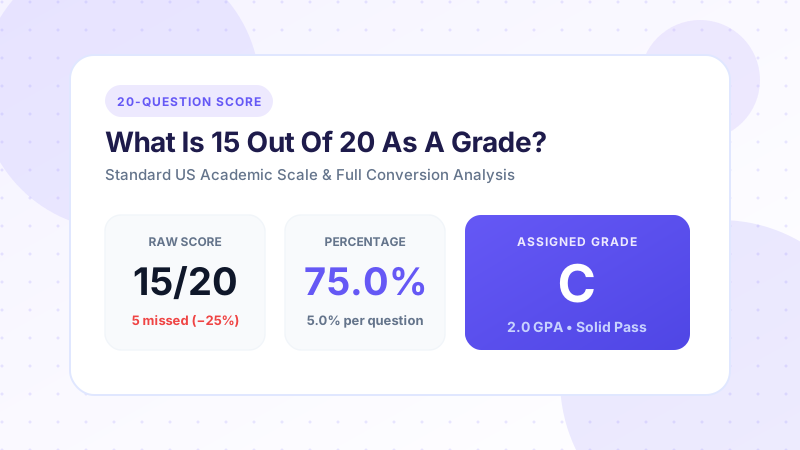
15 out of 20 is exactly 75.00%, which equals a solid letter grade of C on the standard United States 10-point grading scale. On a 20-question test or quiz, each question accounts for exactly 5 percentage points. Missing 5 questions costs 25 percentage points, placing your score at a 2.0 unweighted GPA value.
What Is 15 Out of 20 as a Percentage and Letter Grade?
A score of 15 out of 20 equals 75%, calculated by dividing 15 earned points by 20 possible points and multiplying by 100 ((15 ÷ 20) × 100 = 75%). On the standard United States grading scale, a 75% falls squarely within the C grade band, which spans from 73.0% to 76.9%.
Because the total number of questions is 20, every single question represents exactly 5.0 percentage points (100% ÷ 20 = 5%). That uniform 5% step makes calculating your score straightforward, but it also creates wide jumps between whole-question results: 15 correct is 75% (C), 16 correct is 80% (B−), and 14 correct is 70% (C−).
A 75% is considered an average, satisfactory passing grade across primary, secondary, and post-secondary academic institutions. It demonstrates that you answered three-quarters of the test material correctly. While comfortably above the typical failing threshold of 60%, it leaves room for strategic grade recovery on future assignments.
Full 20-Question Score Conversion Chart (Every Mark from 0/20 to 20/20)
When scoring a 20-question quiz or exam, teachers and students benefit from having every potential score mapped out in advance. Below is the complete conversion matrix mapping raw points, missed questions, percentages, standard letter grades, and unweighted 4.0 GPA points:
To convert any other custom test score, you can run the numbers through our interactive score out of X converter or print out a ready-to-use breakdown on the grading scale for 20 questions page.
| Questions Correct | Questions Missed | Percentage Score | Standard Letter Grade | Unweighted GPA Points |
|---|---|---|---|---|
| 20 | 0 | 100.0% | A+ / A | 4.0 |
| 19 | 1 | 95.0% | A | 4.0 |
| 18 | 2 | 90.0% | A− | 3.7 |
| 17 | 3 | 85.0% | B | 3.0 |
| 16 | 4 | 80.0% | B− | 2.7 |
| 15 | 5 | 75.0% | C | 2.0 |
| 14 | 6 | 70.0% | C− | 1.7 |
| 13 | 7 | 65.0% | D | 1.0 |
| 12 | 8 | 60.0% | D− | 0.7 |
| 11 | 9 | 55.0% | F | 0.0 |
| 10 | 10 | 50.0% | F | 0.0 |
| 9 | 11 | 45.0% | F | 0.0 |
| 8 | 12 | 40.0% | F | 0.0 |
| 7 | 13 | 35.0% | F | 0.0 |
| 6 | 14 | 30.0% | F | 0.0 |
| 5 | 15 | 25.0% | F | 0.0 |
| 4 | 16 | 20.0% | F | 0.0 |
| 3 | 17 | 15.0% | F | 0.0 |
| 2 | 18 | 10.0% | F | 0.0 |
| 1 | 19 | 5.0% | F | 0.0 |
| 0 | 20 | 0.0% | F | 0.0 |
Why 15 Out of 20 Lands on a C (And Why C+ Is Mathematically Impossible)
A frequent point of confusion among students receiving a 15/20 mark is why their grade is reported as a flat C rather than a C+. The answer lies in the mathematical discretization of 20-item tests.
On standard plus/minus scales, the C+ bracket starts at 77.0% (running up to 79.9%). Because each question on a 20-item test is worth 5 percentage points, scores only exist at whole multiples of 5: 70%, 75%, 80%, 85%, 90%, 95%, and 100%. To achieve exactly 77.0%, a student would need to answer 15.4 questions correctly (20 × 0.77 = 15.4).
Because tests without partial credit only reward whole numbers, 15 correct yields 75% (C) and 16 correct steps completely over the C+ band directly into 80% (B−). This mathematical dead zone means that on a 20-question test without half-points, nobody can earn a C+, B+, or A+.
If your instructor awards half-points for partial credit on multi-step problems, earning 15.5 out of 20 yields 77.5%, which successfully unlocks the C+ grade.
How Does 15 Out of 20 Compare Across Different Grading Scales?
While the standard 10-point scale is the dominant system across American high schools and universities, grading policies vary by school district, academic institution, and international jurisdiction.
In certain private academies and regional public school systems that employ the strict 7-point grading scale (where an A is 93–100, B is 85–92, C is 77–84, and D is 70–76), a score of 75% drops from a C to a D. If your school utilizes a 7-point scale, 15 out of 20 is on the verge of a failing grade, requiring 16 correct (80%) just to secure a C. You can inspect exact district cutoffs using our 10-point vs 7-point grading scale guide.
| Grading Scale System | Percentage Range for 15/20 (75%) | Assigned Letter Grade | Quality Points / Standing |
|---|---|---|---|
| Standard 10-Point Scale (US Public) | 73.0% – 76.9% | C | 2.0 GPA (Satisfactory Pass) |
| Strict 7-Point Scale (Select Southern Districts) | 70.0% – 76.9% | D | 1.0 GPA (Below Average / Conditional Pass) |
| Standard Plus/Minus College Scale | 73.0% – 76.9% | C | 2.00 Quality Points |
| Non-Plus/Minus High School Scale | 70.0% – 79.9% | C | 2.00 Quality Points |
| Canadian University Scale | 73.0% – 76.9% | B / B− | 2.70 – 3.00 (Varies by Province) |
| UK Undergraduate Honours System | 70.0%+ | First Class Honours (1st) | Top-tier academic achievement equivalent |
What Is the GPA Value of a 15 Out of 20 Score?
In the standard United States collegiate and secondary education system, a 75% (C) translates to 2.00 grade points on a 4.0 unweighted GPA scale. On a weighted scale, an honors course provides a +0.5 boost (2.50 quality points), and an Advanced Placement (AP) or International Baccalaureate (IB) course provides a +1.0 boost (3.00 quality points).
Because quality points are weighted by credit hours, a single 15/20 quiz does not directly change your GPA to a 2.0. Instead, your cumulative GPA reflects the final letter grade earned across all course credits: if you hold a 3.50 GPA, a final course grade of C pulls your average downward, whereas for a student with a 1.80 GPA, a C helps raise their standing toward good academic status.
To see how your overall numbers shift across multiple terms, use our cumulative GPA calculator and college GPA calculator.
How Much Does a 15/20 Quiz Actually Change Your Final Course Grade?
A single assessment score only impacts your overall standing according to the weight assigned to that assignment category in your course syllabus. Most professors and teachers group grades into categories such as Homework, Quizzes, Midterms, and Final Exams.
Consider three realistic gradebook scenarios where a student holds an 88% (B+) course average before receiving a 15/20 (75%) on a quiz:
- Minor Weekly Quiz (Category = 10% of Course Grade): If this is one of 5 identical quizzes, this specific quiz represents 2.0% of your course grade. Your average shifts from 88.0% to 87.74% (a tiny dip of 0.26 percentage points), easily preserving your B+ standing.
- Moderate Quiz Category (Category = 25% of Course Grade): If quizzes constitute 25% of your grade across just two quizzes, this quiz carries 12.5% of your final grade. Your overall average drops by 1.62 percentage points to 86.38%, shifting you toward a solid B.
- Unweighted Total Points System: If your course uses 500 total points across the semester, this 20-point quiz represents 4% of your grade. Dropping 5 points reduces your maximum possible semester score from 100% to 99.0%.
How Many Questions Can You Miss on a 20-Question Test to Keep an A or B?
When heading into a 20-question test, knowing your maximum allowable error count helps manage test anxiety and pacing. The mathematical limits for each target letter grade are:
- To Earn an A (93%+): You can miss at most 1 question (19/20 = 95%). Missing 2 questions drops you to 90%, which is an A−.
- To Earn an A− (90%+): You can miss up to 2 questions (18/20 = 90%).
- To Earn a B (83%+): You can miss up to 3 questions (17/20 = 85%). Missing 4 questions drops you to 80% (B−).
- To Earn a C (73%+): You can miss up to 5 questions (15/20 = 75%). Missing 6 questions drops you to 70% (C−).
- To Pass the Test (60%+): You can miss up to 8 questions (12/20 = 60%). Missing 9 questions results in a failing score of 55%.
Action Plan: How to Mathematically Rebound from a 75% Score
If your goal is to finish the term with an A or a B, a 75% on an early 20-question quiz is easily recoverable with focused math and study adjustments.
First, calculate your target score on the next test. If your quiz average is sitting at 75% and you need an 85% quiz average across two quizzes, use the formula (2 × 85) − 75 = 95%. Scoring a 19 out of 20 (95%) on the second quiz brings your category average directly to an 85% B.
Second, remember that quizzes rarely decide a semester on their own; projects and midterm exams typically carry 3 to 4 times more weight. Scoring a 92% on a 100-point midterm will quickly overshadow a 15/20 quiz.
Third, conduct an error audit on the 5 missed questions to separate careless execution slips from core conceptual misunderstandings, and check your syllabus for extra credit or final exam replacement policies. You can plan your exact final exam target using our final grade calculator.
Frequently Asked Questions
What is 15 out of 20 as a percentage?+
15 out of 20 is exactly 75%. To find this percentage, divide 15 by 20 to get 0.75, then multiply by 100.
What letter grade is 15 out of 20?+
15 out of 20 is a C on the standard 10-point United States academic grading scale. It falls within the regular C bracket (73% to 76.9%).
Is 15 out of 20 a passing grade?+
Yes, 15 out of 20 is a passing grade in virtually all high schools and colleges. A 75% is well above the standard 60% (D−) high school passing line and satisfies the 70% (C−) or 73% (C) minimum required for college prerequisite courses.
Why is 15 out of 20 not a C+?+
15 out of 20 is not a C+ because the C+ bracket starts at 77%, which requires 15.4 correct answers on a 20-question test. Without partial credit, scores step directly from 75% (C) to 80% (B−), skipping the C+ tier entirely.
What GPA is 15 out of 20?+
On an unweighted 4.0 GPA scale, a 75% (C) is worth 2.0 quality points. In an honors class it is worth 2.5 points, and in an AP or IB class it is worth 3.0 points.
What is 15 out of 20 on a 7-point grading scale?+
On a strict 7-point grading scale, 15 out of 20 (75%) is a D. Under this system, a C requires at least 77% (16 questions correct), making 75% a below-average score near the failing threshold.
How many questions can you miss out of 20 to get an A?+
To get an A (93% or higher), you can only miss 1 question (19/20 = 95%). Missing 2 questions yields 90%, which is an A−.
Can a 15 out of 20 be rounded up to an 80% (B−)?+
No, a 75% cannot be rounded up to an 80%. Standard academic rounding policies only apply to scores within 0.5% of a cutoff (such as rounding 79.5% to 80%), meaning a full 5% deficit cannot be bridged by rounding rules alone.
How much does each question count on a 20-question test?+
Each question is worth exactly 5 percentage points (100 ÷ 20 = 5.0%). Missing 1 question leaves a 95%, missing 2 leaves a 90%, and missing 5 leaves a 75%.
What is 15.5 out of 20 as a grade?+
If an instructor awards half-credit, 15.5 out of 20 is 77.5%, which qualifies as a C+ on the standard plus/minus grading scale.
Is a 75% a good grade in college?+
In college, a 75% is a respectable passing grade that meets all general education and degree requirements. However, for students targeting graduate school or competitive professional programs where a 3.5+ GPA is desired, a 2.0 grade point contribution will pull down your average.
How do I calculate my grade if other assignments have different point values?+
Divide the total points you have earned across all assignments by the total points possible, then multiply by 100. If your course uses weighted categories, multiply your average in each category by its syllabus weight percentage and add them together using our grade calculator.
Muhammd Salman
I build and maintain Grade Calculator independently. Every worked example on this site is checked against the underlying formula, with notes on where school or instructor policy can change the result. More about this site →