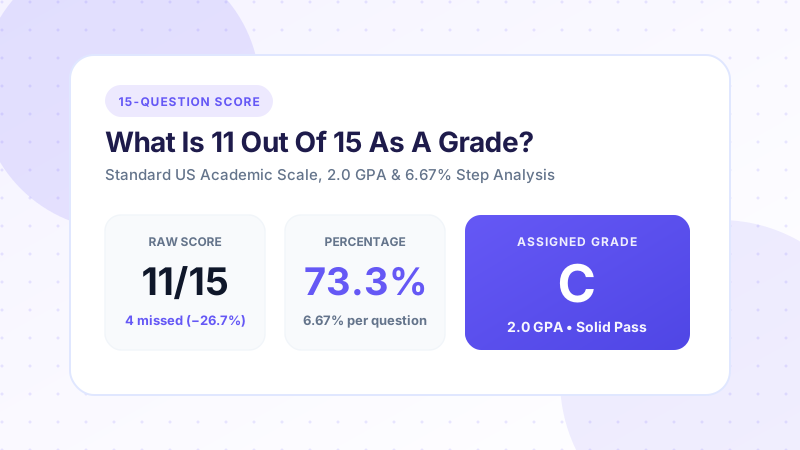
11 out of 15 is exactly 73.33%, which corresponds to a solid letter grade of C on the standard United States 10-point grading scale. On a 15-question test, each question is worth 6.67 percentage points. Missing 4 questions deducts 26.67 percentage points, resulting in a 2.0 unweighted GPA value.
What Is 11 Out of 15 as a Percentage and Letter Grade?
A score of 11 out of 15 equals 73.33%, calculated by dividing 11 earned points by 15 total points and multiplying by 100 ((11 ÷ 15) × 100 = 73.333...%). On the standard United States academic scale, a 73.3% sits right in the lower half of the C grade bracket, which spans from 73.0% to 76.9%.
Because a 15-question test divides 100% across fewer items, each individual question carries a substantial weight of 6.67 percentage points (100% ÷ 15 = 6.666...%). This steep per-question impact means that every mistake significantly alters your percentage: 11 correct is 73.3% (C), 12 correct is 80.0% (B−), and 10 correct is 66.7% (D).
A 73.3% represents a satisfactory passing score for general high school and introductory college coursework. It confirms that you mastered nearly three-quarters of the tested material. However, because it sits just 0.34 percentage points above the C− threshold (73.0%), it is an important score to stabilize with strategic study habits.
Full 15-Question Score Conversion Chart (Every Mark from 0/15 to 15/15)
Because 15-question quizzes and short tests do not produce round numbers, having the exact wrong-answer-to-percentage table eliminates guesswork for teachers and students alike. Below is the complete conversion matrix for every score on a 15-item assessment:
To evaluate any other custom exam length or fractional score, run your numbers through our score out of X converter or print out the complete grading scale for 15 questions table.
| Questions Correct | Questions Missed | Percentage Score | Standard Letter Grade | Unweighted GPA Points |
|---|---|---|---|---|
| 15 | 0 | 100.0% | A+ / A | 4.0 |
| 14 | 1 | 93.33% | A | 4.0 |
| 13 | 2 | 86.67% | B | 3.0 |
| 12 | 3 | 80.00% | B− | 2.7 |
| 11 | 4 | 73.33% | C | 2.0 |
| 10 | 5 | 66.67% | D | 1.0 |
| 9 | 6 | 60.00% | D− | 0.7 |
| 8 | 7 | 53.33% | F | 0.0 |
| 7 | 8 | 46.67% | F | 0.0 |
| 6 | 9 | 40.00% | F | 0.0 |
| 5 | 10 | 33.33% | F | 0.0 |
| 4 | 11 | 26.67% | F | 0.0 |
| 3 | 12 | 20.00% | F | 0.0 |
| 2 | 13 | 13.33% | F | 0.0 |
| 1 | 14 | 6.67% | F | 0.0 |
| 0 | 15 | 0.00% | F | 0.0 |
Why 15-Question Tests Create Wide 6.67% Steps and Skip Letter Tiers
Students are often startled by how dramatically their grade swings on a 15-question quiz compared to a 50- or 100-question exam. The reason is the 6.67% step interval.
On a 100-question test, each question is 1.0%, allowing students to land on every nuanced letter increment (C, C+, B−, B, B+, A−, A). But on a 15-question test, whole-number scoring completely leaps over multiple letter bands. For instance, 11 correct is 73.33% (C) and 12 correct is 80.00% (B−). Because the C+ bracket exists exclusively between 77.0% and 79.9%, it is mathematically impossible to receive a C+ on a 15-question test without partial credit.
Likewise, the A− band (90.0% to 92.9%) is completely bypassed: 13 correct is 86.67% (B) and 14 correct jumps straight to 93.33% (A). Understanding these discrete leaps helps you recognize that 11/15 is not a failing grade, but simply a product of coarse question granularity.
How Does 11 Out of 15 Compare Across Different Grading Scales?
While the standard 10-point scale is the benchmark across the majority of American high schools and universities, grading systems vary substantially by district and country:
In school districts that strictly enforce the traditional 7-point scale (where A is 93–100, B is 85–92, C is 77–84, and D is 70–76), an 11 out of 15 (73.33%) falls below the 77% threshold and is recorded as a D. If your school uses this scale, check our 10-point vs 7-point grading scale guide to verify your standing.
| Grading Scale System | Percentage for 11/15 (73.33%) | Assigned Letter Grade | Quality Points / Standing |
|---|---|---|---|
| Standard 10-Point Scale (US Public) | 73.0% – 76.9% | C | 2.0 GPA (Satisfactory Pass) |
| Strict 7-Point Scale (Select Southern Districts) | 70.0% – 76.9% | D | 1.0 GPA (Below Average / Conditional Pass) |
| Standard Plus/Minus College Scale | 73.0% – 76.9% | C | 2.00 Quality Points |
| Non-Plus/Minus High School Scale | 70.0% – 79.9% | C | 2.00 Quality Points |
| Canadian University Scale | 73.0% – 76.9% | B / B− | 2.70 – 3.00 (Varies by Province) |
| UK Undergraduate Honours System | 70.0%+ | First Class Honours (1st) | Top-tier academic distinction |
What Is the GPA Value of an 11 Out of 15 Score?
On the standard 4.0 collegiate grading scale, a 73.33% (C) translates to 2.00 quality points in an unweighted course. In an honors course that provides a +0.5 boost, it is worth 2.50 points, and in an Advanced Placement (AP) or International Baccalaureate (IB) course it earns 3.00 quality points.
Earning a C contributes positively toward credit accumulation, but if your cumulative GPA goal is a 3.0 or higher, repeated C grades will gradually pull your cumulative GPA downward. Conversely, if you are attempting to recover from academic difficulty and hold a 1.8 GPA, an unweighted 2.0 course grade helps lift your overall standing.
You can test how this grade affects your semester and multi-year trajectory with our cumulative GPA calculator and college GPA calculator.
How Much Does an 11/15 Quiz Impact Your Final Semester Grade?
The real-world consequence of a 73.33% quiz depends strictly on the category weight specified in your instructor's syllabus. In most high school and college classes, short 15-question quizzes belong to a low-stakes category:
Consider two realistic syllabus scenarios where a student currently holds an 86% (B) course average before receiving an 11/15 (73.33%) on a quiz:
- Quizzes Are 10% of the Final Grade (5 Quizzes Total): This single quiz represents just 2.0% of your total course grade. Your average shifts from 86.0% to 85.75%—a negligible drop of 0.25 percentage points that preserves your solid B standing.
- Quizzes Are 20% of the Final Grade (4 Quizzes Total): This quiz carries 5.0% of your overall mark. Your grade shifts from 86.0% to 85.37%, keeping you well within the B grade band.
How Many Questions Can You Miss on a 15-Question Test to Keep an A or B?
When preparing for a 15-question quiz, keeping these exact error thresholds in mind helps you pace your test-taking:
- To Earn an A (93%+): You can miss at most 1 question (14/15 = 93.33%). Missing 2 questions immediately drops you to 86.67% (a B).
- To Earn a B (83%+): You can miss up to 2 questions (13/15 = 86.67%). Missing 3 questions leaves you at 80.00% (B−).
- To Earn a C (73%+): You can miss up to 4 questions (11/15 = 73.33%). Missing 5 questions drops you into the D range (10/15 = 66.67%).
- To Pass the Test (60%+): You can miss up to 6 questions (9/15 = 60.00%). Missing 7 questions results in a failing score of 53.33% (F).
The Recovery Blueprint: How to Mathematically Rebound from an 11/15
An 11 out of 15 is a minor blip that can be completely neutralized with clear mathematical recovery tactics.
If you need an 85% quiz average across two 15-question quizzes, apply the target-grade formula: (2 × 85) − 73.33 = 96.67%. Scoring a 15 out of 15 (100%) or 14.5 with partial credit on the second quiz easily pulls your combined quiz average up to an 86.67% B.
Remember that major unit exams and midterms carry much higher weight than quizzes. Scoring well on an upcoming 100-point test will overwhelm the minor point gap from an 11/15 quiz. Use our final grade calculator to project what you need on your final exam to secure your target course letter.
Frequently Asked Questions
What is 11 out of 15 as a percentage?+
11 out of 15 is exactly 73.33%. To calculate this percentage, divide 11 by 15 to get 0.7333, then multiply by 100.
What letter grade is 11 out of 15?+
11 out of 15 is a C on the standard 10-point United States academic grading scale. It falls within the regular C bracket (73% to 76.9%).
Is 11 out of 15 a passing grade?+
Yes, 11 out of 15 is a passing grade in high school and college. A 73.33% is above the 60% high school graduation minimum and satisfies the standard 70% (C−) or 73% (C) prerequisite requirement.
Why is each question worth so much on a 15-question test?+
Each question is worth 6.67 percentage points because 100% is divided by only 15 items (100 ÷ 15 = 6.67%). That means every missed question carries nearly seven times more impact than on a 100-question exam.
What GPA is 11 out of 15?+
On an unweighted 4.0 GPA scale, a 73.33% (C) translates to 2.00 quality points. In an honors course it is worth 2.50 points, and in an AP course it earns 3.00 points.
What is 11 out of 15 on a 7-point grading scale?+
On a strict 7-point scale, 11 out of 15 (73.33%) is a D. Under this system, a C requires at least 77% (12 correct), so 73.33% is a below-average score near the failing line.
How many questions can you miss on a 15-question test to get an A?+
To get an A (93% or higher), you can only miss 1 question (14/15 = 93.33%). Missing 2 questions drops you directly to an 86.67% B.
Can an 11 out of 15 be rounded up to a C+?+
No, standard grade rounding policies only round numbers within 0.5% of a boundary (such as 76.5% to 77.0%). A 73.33% is nearly 4 percentage points away from the 77% C+ cutoff.
What is 11.5 out of 15 as a grade?+
If your instructor awards half-credit, 11.5 out of 15 equals 76.67%, which qualifies as a high C on the standard plus/minus grading scale.
What happens if I miss 5 questions on a 15-question test?+
Missing 5 questions leaves you with 10 correct, which equals 66.67%—a D grade and a 1.0 GPA value.
How do I calculate my overall grade after this quiz?+
Multiply your quiz score (73.33%) by its percentage weight in your course syllabus, then multiply your scores in all other categories by their respective weights and add the results together using our grade calculator.
What score do I need on the next quiz to average an 80%?+
To achieve an 80% average across two quizzes after getting 73.33%, you need an 86.67% (13 out of 15) on the second quiz: (2 × 80) − 73.33 = 86.67%.
Muhammd Salman
I build and maintain Grade Calculator independently. Every worked example on this site is checked against the underlying formula, with notes on where school or instructor policy can change the result. More about this site →