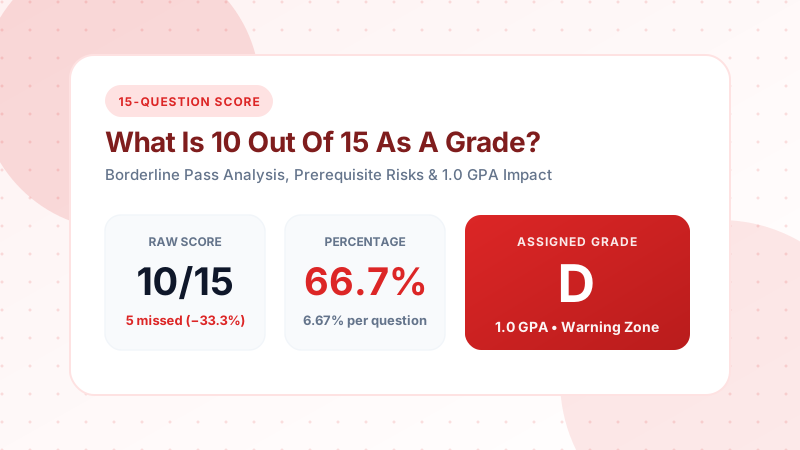
10 out of 15 is exactly 66.67%, which equals a letter grade of D (or D+ on plus/minus scales) on the standard United States 10-point grading scale. On a 15-question test, each question is worth 6.67 percentage points. Missing 5 questions costs 33.33 percentage points, earning a 1.0 unweighted GPA value.
What Is 10 Out of 15 as a Percentage and Letter Grade?
A score of 10 out of 15 equals 66.67%, determined by dividing 10 earned points by 15 total points and multiplying by 100 ((10 ÷ 15) × 100 = 66.666...%). On the standard United States academic scale with plus/minus distinctions, 66.7% is typically classified as a D or D+ (with the D band extending from 63.0% to 66.9% and D+ spanning 67.0% to 69.9%).
Because 15 questions divide 100 percentage points, each single question carries a massive 6.67% penalty (100% ÷ 15 = 6.67%). That means missing just 5 questions strips away a full third of your potential grade: 10 correct is 66.7% (D), 11 correct is 73.3% (C), and 9 correct is 60.0% (D−).
While 66.7% is technically a passing grade in high school, it is considered deficient performance. In college settings, a 66.7% fails to satisfy major prerequisites and can endanger your academic standing if not offset by stronger grades.
Full 15-Question Score Conversion Chart (Every Mark from 0/15 to 15/15)
To see exactly how a 10/15 compares to every other score on a 15-item quiz or assignment, consult the comprehensive 15-question conversion matrix below:
To evaluate any other test length or check fractional credit scores, enter your numbers into our score out of X converter or review the grading scale for 15 questions page.
| Questions Correct | Questions Missed | Percentage Score | Standard Letter Grade | Unweighted GPA Points |
|---|---|---|---|---|
| 15 | 0 | 100.0% | A+ / A | 4.0 |
| 14 | 1 | 93.33% | A | 4.0 |
| 13 | 2 | 86.67% | B | 3.0 |
| 12 | 3 | 80.00% | B− | 2.7 |
| 11 | 4 | 73.33% | C | 2.0 |
| 10 | 5 | 66.67% | D | 1.0 |
| 9 | 6 | 60.00% | D− | 0.7 |
| 8 | 7 | 53.33% | F | 0.0 |
| 7 | 8 | 46.67% | F | 0.0 |
| 6 | 9 | 40.00% | F | 0.0 |
| 5 | 10 | 33.33% | F | 0.0 |
| 4 | 11 | 26.67% | F | 0.0 |
| 3 | 12 | 20.00% | F | 0.0 |
| 2 | 13 | 13.33% | F | 0.0 |
| 1 | 14 | 6.67% | F | 0.0 |
| 0 | 15 | 0.00% | F | 0.0 |
How Close Is 10 Out of 15 to Failing? The Critical Borderline
The defining danger of a 10 out of 15 on a 15-question test is its proximity to the failure threshold.
In standard American grading, the absolute lowest passing score is 60.0% (a D−). On a 15-question test, 60.0% equals exactly 9 questions correct. That means at 10 correct, you are standing exactly one question away from the failing boundary. If you miss a 6th question, your score drops to 9/15 (60.0%), and missing a 7th question (8/15) immediately results in an outright failing grade of 53.33% (F).
This extreme sensitivity underscores why short quizzes must be treated with deliberate review: small careless mistakes that cost just 2 questions carry the mathematical force of an entire letter grade.
How Does 10 Out of 15 Compare Across Different Grading Scales?
Grading scales vary substantially across high schools, universities, and international programs:
In school districts that use the strict 7-point grading scale (where A is 93–100, B is 85–92, C is 77–84, and D is 70–76), any score below 70.0% is classified as a failing grade of F. In those districts, a 10 out of 15 (66.67%) is an automatic F, requiring immediate remediation. Check our 10-point vs 7-point grading scale guide to verify your school's specific cutoffs.
| Grading Scale System | Percentage for 10/15 (66.67%) | Assigned Letter Grade | Quality Points / Standing |
|---|---|---|---|
| Standard 10-Point Scale (US Public) | 63.0% – 66.9% | D | 1.0 GPA (Below Average / Warning Zone) |
| Strict 7-Point Scale (Select Southern Districts) | Below 70.0% | F | 0.0 GPA (Failing Grade) |
| Standard Plus/Minus College Scale | 67.0% – 69.9% / 65–66.9% | D / D+ | 1.00 – 1.30 Quality Points |
| Non-Plus/Minus High School Scale | 60.0% – 69.9% | D | 1.00 Quality Points |
| Canadian University Scale | 65.0% – 69.9% | C / C+ | 2.00 – 2.30 (Passing Standing) |
| UK Undergraduate Honours System | 60.0% – 69.9% | Upper Second (2:1) | Strong academic standing |
What Is the GPA Value and Academic Risk of a 10 Out of 15 Score?
On the standard 4.0 collegiate grading scale, a 66.67% (D) yields only 1.00 quality point (or 1.30 quality points if your school awards a D+).
Most colleges and universities enforce an academic probation policy requiring students to maintain at least a 2.00 cumulative GPA (a C average). Receiving a 1.00 grade point contribution in any 3- or 4-credit course severely damages your overall average and will drag a student into academic warning if not countered by A or B grades in other subjects.
To monitor how this score influences your overall standing, use our cumulative GPA calculator and college GPA calculator.
How Much Does a 66.7% Quiz Affect Your Overall Course Grade?
Despite the low score, a 10/15 on a quiz does not mean your semester is ruined. The actual damage depends strictly on the weight of the quiz category in your course syllabus:
Consider two realistic gradebook models where a student holds an 84% (B) average before scoring a 10/15 (66.67%) on a quiz:
- Quizzes Are 10% of the Final Grade (5 Quizzes Total): This single quiz represents just 2.0% of your course grade. Your overall course average shifts from 84.0% to 83.65%—a dip of less than 0.35 percentage points that leaves your B grade completely intact.
- Quizzes Are 20% of the Final Grade (4 Quizzes Total): This quiz carries 5.0% of your final mark. Your overall average shifts from 84.0% to 83.13%, remaining securely within the B range.
The Strategic Turnaround: How to Mathematically Recover from a 10/15
A 10 out of 15 is a clear diagnostic alert that requires immediate, calculated study adjustments.
First, calculate the score you need on your next quiz to bring your quiz category up to a respectable 80% (B−). If your teacher averages two quizzes, use the target-grade formula: (2 × 80) − 66.67 = 93.33%. Scoring a 14 out of 15 (93.33% A) on quiz two completely pulls your combined average up to an 80% B−.
Second, focus on major exams and homework. Homework is often graded on completion and can easily yield 100%, while midterm exams carry 30% to 50% of your grade. A high score on your first midterm will dilute a 10/15 quiz almost entirely. Use our final grade calculator to project your path to an overall course B.
Frequently Asked Questions
What is 10 out of 15 as a percentage?+
10 out of 15 is exactly 66.67%. To calculate this percentage, divide 10 by 15 to get 0.6667, then multiply by 100.
What letter grade is 10 out of 15?+
10 out of 15 is a D on the standard 10-point United States grading scale. On plus/minus scales, it falls in the D or low D+ range.
Is 10 out of 15 a passing grade?+
Yes, 10 out of 15 is technically a passing grade in high school, as it sits above the 60% minimum cutoff. However, in college, a 66.67% D generally does not satisfy major prerequisite requirements.
What GPA is 10 out of 15?+
On an unweighted 4.0 GPA scale, a 66.67% (D) earns 1.00 quality point. If your institution records it as a D+, it is worth 1.30 quality points.
What is 10 out of 15 on a 7-point grading scale?+
On a strict 7-point grading scale, 10 out of 15 (66.67%) is a failing grade of F, because any score below 70% is considered failing under that system.
How many questions did I miss on a 10 out of 15?+
You missed 5 questions out of 15 (15 − 10 = 5). Each question was worth 6.67 percentage points, resulting in a 33.33% total deduction.
How close is 10 out of 15 to failing?+
10 out of 15 is exactly 1 question away from the failing threshold. Missing one more question (9/15 = 60%) brings you to the lowest pass, and missing two (8/15 = 53.33%) is an F.
What score do I need on my next 15-question quiz to get an 80% average?+
To achieve an 80% average across two quizzes after getting 66.67%, you need a 93.33% (14 out of 15) on the second quiz: (2 × 80) − 66.67 = 93.33%.
What is 10.5 out of 15 as a grade?+
If your instructor awards half-credit, 10.5 out of 15 equals 70.00%, which qualifies as a C− on the standard plus/minus scale.
Can a 10 out of 15 be rounded up to a C?+
No, standard rounding policies only apply to scores within 0.5% of a boundary (such as 69.5% to 70.0%). A 66.67% is over 3 percentage points away from a C.
Will a 10 out of 15 ruin my semester grade?+
No. In most classes, a single quiz accounts for only 2% to 5% of your final semester grade, lowering your overall course standing by less than half a percentage point.
How do I calculate my overall grade after this quiz?+
Multiply your quiz score (66.67%) by its syllabus weight percentage, multiply your scores in all other categories by their weights, and add them together using our grade calculator.
Muhammd Salman
I build and maintain Grade Calculator independently. Every worked example on this site is checked against the underlying formula, with notes on where school or instructor policy can change the result. More about this site →