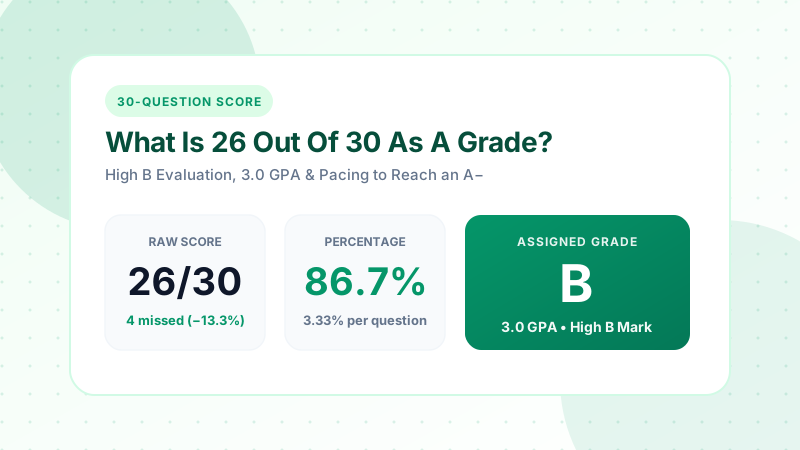
26 out of 30 is exactly 86.67%, which represents a high B (or B+ in schools that round up at 86.5%) on the standard United States 10-point grading scale. On a 30-question test, each question is worth 3.33 percentage points. Missing 4 questions deducts 13.33 percentage points, earning a 3.0 unweighted GPA.
What Is 26 Out of 30 as a Percentage and Letter Grade?
A score of 26 out of 30 equals 86.67%, calculated by dividing 26 earned points by 30 total points and multiplying by 100 ((26 ÷ 30) × 100 = 86.666...%). On the standard United States academic grading scale, 86.7% sits at the very peak of the solid B bracket (which spans from 83.0% to 86.9%). In academic institutions that round scores to the nearest whole percentage, an 86.7% rounds up to 87.0%, qualifying as a B+.
Because a 30-question test offers more granular point steps than shorter quizzes, each question is worth exactly 3.33 percentage points (100% ÷ 30 = 3.333...%). This fine-grained spacing creates smooth transitions between letter grades: 26 correct is 86.7% (B / high B), 27 correct is 90.0% (A−), and 25 correct is 83.3% (B).
An 86.7% is a strong, above-average academic achievement across secondary and collegiate coursework. It demonstrates thorough comprehension of over eight out of every ten questions and positions you just one question away from the honor-tier A bracket.
Full 30-Question Score Conversion Chart (Every Mark from 0/30 to 30/30)
Below is the complete conversion matrix mapping every possible score on a 30-question test to its exact percentage, standard letter grade, unweighted 4.0 GPA points, and performance summary:
To evaluate any other custom exam length or partial-credit score, enter your numbers into our score out of X converter or review the grading scale for 30 questions breakdown.
| Questions Correct | Questions Missed | Percentage Score | Standard Letter Grade | Unweighted GPA Points |
|---|---|---|---|---|
| 30 | 0 | 100.0% | A+ / A | 4.0 |
| 29 | 1 | 96.67% | A | 4.0 |
| 28 | 2 | 93.33% | A | 4.0 |
| 27 | 3 | 90.00% | A− | 3.7 |
| 26 | 4 | 86.67% | B / B+ | 3.0 / 3.3 |
| 25 | 5 | 83.33% | B | 3.0 |
| 24 | 6 | 80.00% | B− | 2.7 |
| 23 | 7 | 76.67% | C | 2.0 |
| 22 | 8 | 73.33% | C | 2.0 |
| 21 | 9 | 70.00% | C− | 1.7 |
| 20 | 10 | 66.67% | D | 1.0 |
| 19 | 11 | 63.33% | D | 1.0 |
| 18 | 12 | 60.00% | D− | 0.7 |
| 17 | 13 | 56.67% | F | 0.0 |
| 16 | 14 | 53.33% | F | 0.0 |
| 15 | 15 | 50.00% | F | 0.0 |
| 10 | 20 | 33.33% | F | 0.0 |
| 5 | 25 | 16.67% | F | 0.0 |
| 0 | 30 | 0.00% | F | 0.0 |
Why 26 Out of 30 Is Just One Question Away from an A−
One of the most encouraging aspects of scoring a 26/30 is how close you were to an A−.
On the standard plus/minus scale, an A− begins at exactly 90.0%. On a 30-question test, 90.0% corresponds to 27 correct answers (30 × 0.90 = 27). That means answering just one additional question correctly—turning 26/30 into 27/30—would have elevated your score by 3.33 percentage points directly into the honor roll A− tier.
Reviewing your exam paper to understand which question you missed will quickly highlight whether it was a minor factual oversight or a computational slip, giving you immediate leverage for the next assessment.
How Does 26 Out of 30 Compare Across Different Grading Scales?
Grading scales vary depending on whether your institution uses plus/minus distinctions, straight letter bands, or regional standards:
In school districts that adhere to the strict 7-point grading scale (where A is 93–100, B is 85–92, C is 77–84, and D is 70–76), a score of 86.67% comfortably qualifies as a solid B, sitting safely above the 85.0% B cutoff. You can explore regional scale differences in our 10-point vs 7-point grading scale guide.
| Grading Scale System | Percentage for 26/30 (86.67%) | Assigned Letter Grade | Quality Points / Standing |
|---|---|---|---|
| Standard 10-Point Scale (US Public) | 83.0% – 86.9% | B / B+ | 3.00 – 3.30 GPA (Above Average) |
| Strict 7-Point Scale (Select Southern Districts) | 85.0% – 92.9% | B | 3.00 GPA (Solid B Standing) |
| Standard Plus/Minus College Scale | 87.0% rounded / 86.7% | B / B+ | 3.00 – 3.30 Quality Points |
| Non-Plus/Minus High School Scale | 80.0% – 89.9% | B | 3.00 Quality Points |
| Canadian University Scale | 85.0% – 89.9% | A / A− | 3.70 – 3.90 GPA (Excellent Achievement) |
| UK Undergraduate Honours System | 70.0%+ | First Class Honours (1st) | Top academic distinction |
What Is the GPA Impact of a 26 Out of 30 Score?
On the standard 4.0 collegiate scale, an 86.67% carries 3.00 quality points for a solid B, or 3.30 quality points if your school records it as a B+.
In an honors course with a +0.5 weight, it yields 3.50 quality points, and in an Advanced Placement (AP) course with a +1.0 weight, it contributes 4.00 quality points. Earning an 86.7% reinforces your status for good academic standing, Greek life eligibility, and scholarship maintenance (which typically require a 3.0 cumulative GPA).
To see how this grade factors into your multi-semester average, run your transcript through our cumulative GPA calculator and high school GPA calculator.
How Much Does an 86.7% Quiz Affect Your Overall Semester Grade?
Because an 86.67% is an above-average score, its effect on your cumulative course grade is almost universally positive or neutral:
Consider two realistic gradebook scenarios where a student holds different course averages before scoring 26/30 (86.67%) on a test:
- You Hold a 93% (A) and Quizzes Are 15% of the Grade: If this test accounts for 3% of your total semester grade, your average dips slightly from 93.0% to 92.81%—a drop of less than 0.2%, preserving your high A− standing.
- You Hold an 80% (B−) and Quizzes Are 20% of the Grade: If this test represents 5% of your grade, your average rises from 80.0% to 80.33%, helping you climb toward a solid B.
How to Turn an 86.7% Test Score into an A by the End of the Semester
Starting with an 86.7% puts you in prime position to finish the course with an A− (90%) or an A (93%).
First, calculate the score you need on your next 30-question test to average an A− (90%). Using the target-grade formula: (2 × 90) − 86.67 = 93.33%. Scoring a 28 out of 30 (93.33% A) on test two brings your combined test average straight to a 90.0% A−.
Second, focus on upcoming midterms and major projects, which typically carry 40% to 60% of your course grade. Scoring well on these high-weight assessments will easily lift your overall mark into the A range. Use our final grade calculator to project what score you need on the final exam to seal an A.
Frequently Asked Questions
What is 26 out of 30 as a percentage?+
26 out of 30 is exactly 86.67%. To calculate this percentage, divide 26 by 30 to get 0.8667, then multiply by 100.
What letter grade is 26 out of 30?+
26 out of 30 is a high B on the standard 10-point United States grading scale. In schools that round up at 86.5%, it is recorded as a B+ (87%).
What is each question worth on a 30-question test?+
Each question is worth 3.33 percentage points because 100% is divided by 30 items (100 ÷ 30 = 3.33%). Missing 1 question gives 96.67%, and missing 2 gives 93.33%.
What GPA is 26 out of 30?+
On an unweighted 4.0 GPA scale, an 86.67% is worth 3.00 grade points for a solid B, or 3.30 grade points if recorded as a B+.
How many questions can you miss on a 30-question test to get an A?+
To get an A (93% or higher), you can miss at most 2 questions (28/30 = 93.33%). Missing 3 questions yields 90.00%, which is an A−.
How many questions can you miss and still pass a 30-question test?+
To pass with the minimum score of 60% (D−), you can miss up to 12 questions (18/30 = 60.00%). Missing 13 questions results in an F (56.67%).
Can a 26 out of 30 be rounded up to an A−?+
No, standard grade rounding only rounds scores within 0.5% of a cutoff (such as 89.5% to 90.0%). An 86.67% is more than 3 percentage points away from an A−.
What is 26.5 out of 30 as a grade?+
If your teacher awards partial credit, 26.5 out of 30 equals 88.33%, which qualifies as a B+ on the standard plus/minus grading scale.
Is 26 out of 30 considered an honor roll grade?+
Yes, an 86.67% (3.0 GPA) qualifies for the B Honor Roll or Merit Roll at most academic institutions.
What is 26 out of 30 on a 7-point grading scale?+
On a strict 7-point scale, 26 out of 30 (86.67%) is a solid B, comfortably above the 85.0% B cutoff.
What score do I need on my next 30-question test to get an A− average?+
To achieve a 90% A− average across two tests after getting 86.67%, you need a 93.33% (28 out of 30) on the second test: (2 × 90) − 86.67 = 93.33%.
How do I calculate my overall grade after this test?+
Multiply your test score (86.67%) by its syllabus weight percentage, multiply your scores in all other categories by their weights, and add them together using our grade calculator.
Muhammd Salman
I build and maintain Grade Calculator independently. Every worked example on this site is checked against the underlying formula, with notes on where school or instructor policy can change the result. More about this site →